
The Verb Is the Control Surface
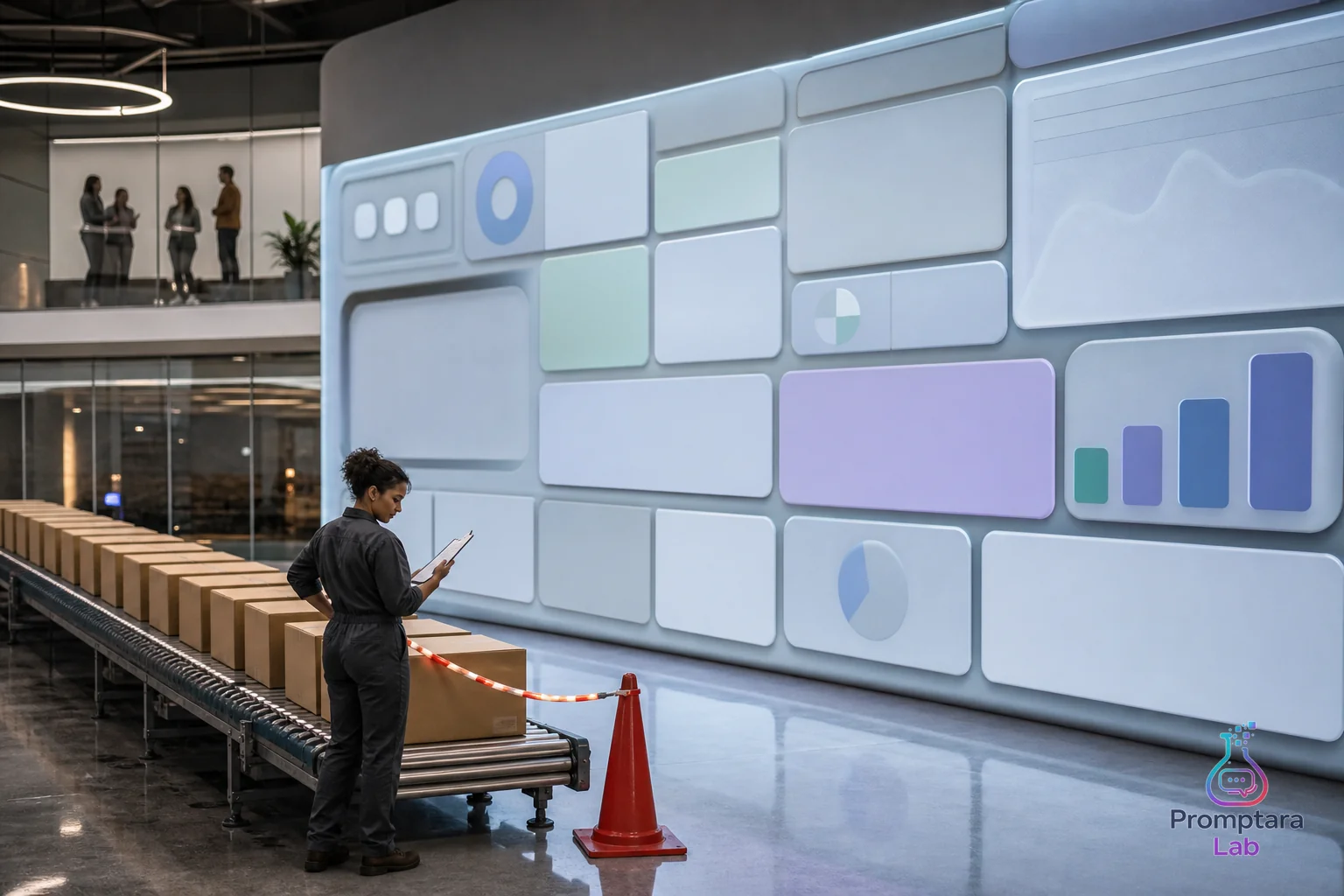
A dashboard full of nouns feels organized.
Observations. Opportunities. Drafts. Visitors. Actions. Messages. Queues.
Nice little buckets. Very tidy. Also a little dangerous.
The noun tells you what kind of object the system is talking about. The verb tells you what the system actually did. In an AI assisted product system, that difference is not grammar trivia. It is the control surface.
Promptara Lab keeps returning to this because automated work gets slippery fast once a system can watch, collect, classify, draft, route, and notify without a person touching every step. A count by itself can look productive while hiding the only thing an operator needed to know: did the system merely see something, or did it change state?
A number without a verb is too easy to flatter
Take a signal pass as a public shape, not a private implementation detail.
One run can observe 99 items, insert 17 new observations, and produce 40 opportunity candidates. Those are all legitimate numbers. They are also three different claims.
Observed means the system saw inputs that met the collection rules.
Inserted means some portion of those inputs became stored evidence.
Proposed means the stored or evaluated evidence was shaped into candidates for later judgment.
Flatten those into one vague number and the whole thing starts wearing a rented suit. Ninety nine sounds big. Seventeen sounds selective. Forty sounds busy. None of them means the same thing.
Another run can observe 91 items, insert 0, and still produce 13 candidates. That is not automatically broken. It might mean the incoming material was already known. It might mean the acceptance rule was strict. It might mean candidate logic drew from existing context. Without verbs, an operator gets pushed toward the laziest conclusion: zero inserted means nothing happened. Sometimes nothing happened. Sometimes the system refused to duplicate evidence and still found something worth triage.
That is why the verb has to sit next to the count. Not in a tooltip. Not in a buried log line. Right there where the operator makes the decision.
The boring verbs are where control lives
The useful automation vocabulary is not glamorous.
Seen. Taken. Queued. Inserted. Skipped. Proposed. Drafted. Sent. Failed. Held. Acted.
These are dull words, which is exactly why they work. They resist theater.
An intake check can report 0 updates seen and 0 messages taken while another queue remains at 6. That is not a heroic narrative. It is a clean boundary. The intake lane had no new work. A different lane still had inventory. If the report only says completed, the operator has to guess whether the system was quiet, blocked, empty, or asleep in a chair.
This is the same reason Promptara Lab has argued that completed successfully is not a status model. Completion is useful as a receipt. It is lousy as the whole story.
Drafted is another good example. A publication engine can create a draft record. Media can be attached. A notification can be sent. Fine. Useful. But drafted is not published, published is not read, read is not trusted, and trusted is not action. If those verbs collapse into output, the system starts congratulating itself for moving objects around.
Operators do not need drama. They need tense.
Past tense: what changed.
Present tense: what is waiting.
Future tense: what needs review before it becomes somebody else’s problem.
Every handoff deserves its own verb
A product system is mostly handoffs wearing a nicer shirt.
A search phrase becomes an observation. An observation becomes a stored record. A record becomes a candidate. A candidate becomes a draft. A draft becomes a public artifact. A visitor becomes an action, or does not.
Each handoff changes the standard of evidence.
Seeing a pattern is cheap. Keeping it is a stronger claim. Turning it into a candidate is stronger again. Publishing from it is stronger still. Asking the audience to do something based on it should require the most care.
This is where teams and solo builders alike get sloppy. They name the pipeline, then stop naming the transitions. Everything becomes content. Everything becomes opportunity. Everything becomes engagement. The words get smoother as the system gets less inspectable.
Promptara Lab is allergic to that smoothing. Not because rough telemetry is pretty. It is not. It has the charm of a receipt found in a coat pocket. But rough telemetry with honest verbs beats a polished dashboard that cannot tell whether the machine selected something or merely noticed it.
That connects to the older Promptara Lab distinction that seeing is not selecting. The same discipline applies one layer deeper: selecting is not inserting, inserting is not assigning, assigning is not shipping, and shipping is not demand.
Verbs also protect refusal
Good systems do not just move work forward. They stop things.
A zero can be a failure, a quiet day, a filter doing its job, a missing measurement, or a broken path. The only way to know is to attach the verb and the boundary.
Zero messages taken is different from zero messages available.
Zero inserted observations is different from zero observed inputs.
Zero contact submissions is different from zero visitors.
A traffic report can show visitors without same day actions across several assets, while one asset records 1 action from 1 visitor. That does not prove a business truth. It gives the operator a clean set of verbs: visited, acted, did not act. From there, product judgment can begin without pretending the dashboard has already reached a verdict.
The trap is treating refusal as an absence. A system that skips duplicates, holds weak candidates, or declines to turn traffic into a conclusion is doing product work. Quietly. Without a cape. Usually without appreciation.
Name the refusal verb and it becomes inspectable. Hide it and it becomes suspicion.
Build the interface around verbs
The agentic framework under the hood of Promptara Lab is useful only if its work can be inspected without clairvoyance. That means the public thinking at Promptara Lab keeps biasing toward small, typed distinctions instead of grand labels.
Do not ask a dashboard only what count changed.
Ask what verb produced the count.
Was it observed or accepted?
Was it inserted or merely available?
Was it proposed or approved?
Was it drafted or published?
Was it sent or acted on?
Was it skipped because the system was careful, or skipped because the system was blind?
The answer will not make the operating surface more glamorous. It may make it less impressive at first glance. Good. Impressive dashboards are often where ambiguity goes to buy a blazer.
A useful automation system should be a little annoying about verbs. It should make the operator confront the handoff before trusting the number. It should refuse to let one green receipt stand in for a chain of decisions.
The number is the evidence.
The verb is the promise.