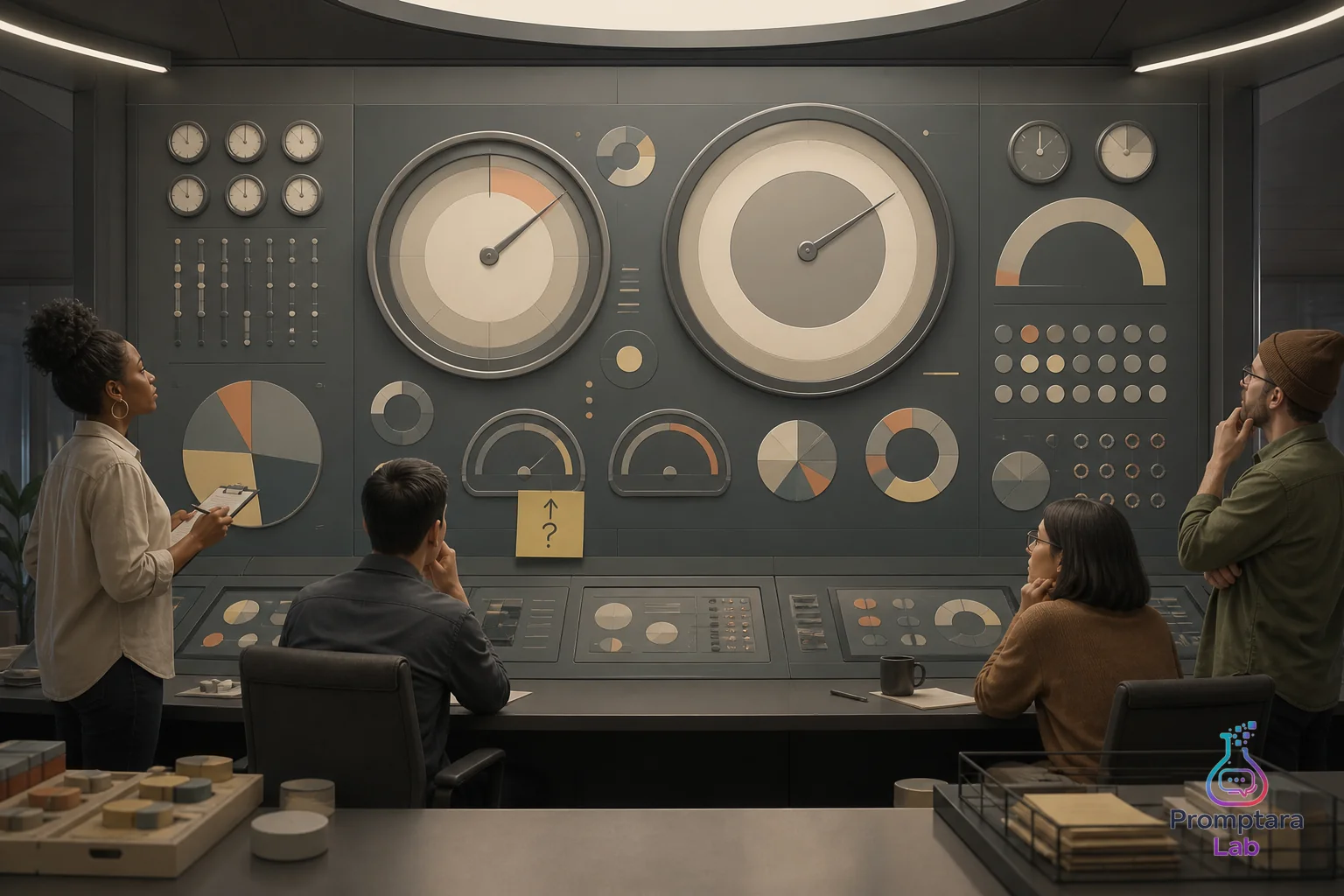
The Handoff Is the Product Surface

A completed automation run is not a handoff. It is the machine saying it reached the end of its assigned path without falling over.
Fine. That is worth knowing. But it is not enough to run a product system.
The handoff is the part where the system tells the next recipient what kind of judgment is now required. Not a celebration. Not a tiny parade of green checks. A working surface.
A signal pass can observe 95 items, accept 13 as new, and shape 39 opportunity candidates. Those are not three versions of the same fact. They are three different handoff points. One asks whether the collection surface is alive. One asks whether the filter is selective enough. One asks whether the candidate pile deserves review time.
Collapse those into “completed successfully” and the operator gets theater with timestamps.
Promptara Lab keeps returning to this principle because small AI assisted systems can now produce more intermediate objects than a person can comfortably inspect. That is useful only if the handoff is designed with the same care as the output.
Completion is not a recipient
Automation likes to finish. Operators like finished things. That mutual weakness creates sloppy systems.
A run can finish after checking a queue where nothing moved. It can finish after producing a draft package. It can finish after finding no messages to accept. It can finish after reporting traffic with no same day action. All of those endings are legitimate. None of them tells the operator what to do next by itself.
The recipient has to be named, even if it is only implied by the surface.
A draft handoff goes to a reviewer. A queue handoff goes to an operator deciding whether the queue is intentionally waiting or quietly rotting. A signal handoff goes to someone judging whether new material is worth converting into work. A traffic handoff goes to someone asking whether attention reached the page without finding a reason to act.
Without that recipient, every output becomes a vague little obligation. Somebody should look at it. Somebody should decide. Somebody should know whether this is good.
That is how automation becomes clerical fog.
This is close to the argument in A Draft Needs a Bill of Materials: generated material needs enough context to be inspected as a package, not admired as a blob. The same rule applies beyond drafts. Every automation output needs a bill of handoff.
The handoff should name the decision
A useful handoff does not need to be long. It needs to be pointed.
Bad handoff: completed.
Better handoff: completed, 13 new items accepted from 95 observed, 39 candidates available for review.
Better still: completed, review candidate quality before adding work, because acceptance and candidate creation are different decisions.
That last sentence is the difference between telemetry and work design.
The system does not have to expose all of its machinery. It should not. Nobody needs a tour of the pipes every morning. But the handoff has to preserve the decision boundary. If observation, acceptance, candidate creation, drafting, notification, and action evidence all land with the same emotional weight, the operator is forced to reverse engineer the system’s intent.
That is expensive. Worse, it rewards the wrong behavior. The loudest number wins. The freshest output wins. The most polished draft wins. The unchanged queue loses because it has no charisma.
A small product system should be rude enough to say what kind of decision is being requested:
- inspect source quality
- review candidate fit
- approve or reject a draft
- ignore a quiet queue
- investigate a stuck queue
- treat traffic without actions as inconclusive
- do nothing because the run produced no new operator work
“Do nothing” is allowed. It just needs to be explicit enough that silence is not confused with neglect.
Unchanged is also a handoff
One of the dullest useful outputs is the unchanged queue.
No updates seen. No messages taken. Queue total before and after: the same.
There is no glamour here. Nobody is framing that on a launch page. Still, it is an important handoff because unchanged can mean several things. The system may be idle by design. The input channel may be quiet. The gate may be correctly refusing work. Or the queue may be accumulating old obligations that nobody wants to name.
The count alone cannot answer that. The handoff has to help the operator decide whether unchanged is acceptable.
This is where many systems get cute and fail. They hide the boring states because they do not feel like progress. Then the operator only sees the exciting surfaces: drafts, candidates, notifications, charts, green checks. The result is a product system biased toward motion, even when the correct decision is restraint.
A publication engine that creates draft records should hand off review context. An intake system that accepts nothing should hand off whether nothing arrived or nothing qualified. A traffic report with visits but no actions should hand off that no strong traffic to action signal is available, not dress the visits up as appetite.
That last distinction is not pessimism. It is respect for the evidence.
Notifications Are Interfaces, Not Confetti made the same point from the notification side. A notification should not merely announce that something happened. It should carry the smallest useful interface for deciding what, if anything, happens next.
The product is the next clean decision
The public surface of a product gets most of the design attention. Fair. Users see it. Buyers judge it. Search engines crawl it. The homepage has to earn its keep.
But inside an AI assisted product system, the handoff is also a product surface. It serves the operator. It constrains the machine. It protects review time. It prevents output from masquerading as progress.
That is the operating bias behind Promptara Lab: the agentic framework under the hood is only useful when its work can be inspected, refused, parked, or converted into deliberate next action.
The handoff is where that discipline shows up.
A weak handoff says, “I did a thing.”
A stronger handoff says, “I did this thing, this part changed, this part did not, and the next decision is yours only if it earns your attention.”
That is less flashy than a dashboard full of motion. It is also harder to fool yourself with, which is the main feature.