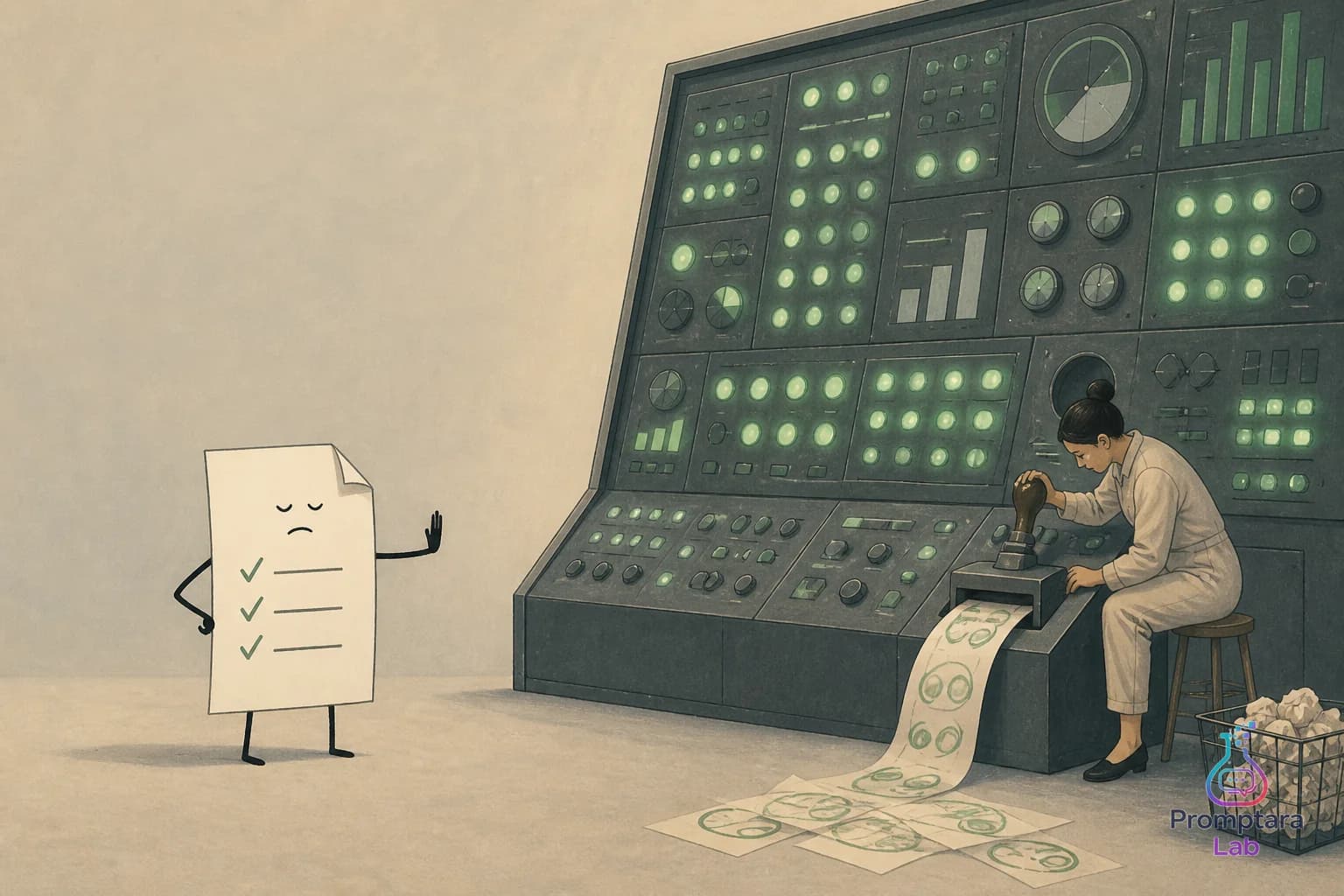
Promotion Is the Unit of Work

Automation loves activity because activity is easy to narrate.
A system checked the queue. A system inspected outside signals. A system drafted channel copy. A system sent a notification. A system counted usage. Fine. Those are useful receipts. They prove the machine did not spend the morning face down in the carpet.
But activity is not the unit of operating work.
Promotion is.
A thing became more expensive. An observation became accepted evidence. A candidate became review inventory. A draft became a publishing decision. A visit became an action signal. A cost line became something worth changing. That movement between states is where the operator inherits the burden.
Most bad automation reporting hides that burden under a polite pile of completed runs.
Completion is cheap. Promotion is expensive.
A completed run can be almost morally neutral. It reached the end. It did not crash. It produced a status line. Good. Nobody is mad at the little machine for finishing its chores.
The cost begins when the output crosses a boundary.
A signal pass can inspect a hundred outside inputs and insert one new item. Another can inspect fewer inputs and insert dozens. Neither number is automatically better. The useful question is not how much the system saw. It is what the system allowed to move forward, and what that movement now demands from a person or product surface.
The same applies to drafts. A publication engine creating a draft is not the same thing as publishing, endorsing, or proving market appetite. A draft is promoted inventory. It now asks for review. If it includes media, channel packaging, links, and captions, it asks for a more specific review than a paragraph in a notes app. The words are not the whole object.
Even usage cost needs this treatment. A small daily bill across a few requests is not automatically reassuring. Cheap activity can still create expensive review work. Expensive activity can be justified if it promotes the right evidence. The bill is a meter. Promotion tells you whether the meter bought anything worth carrying.
Promptara Lab keeps coming back to this because automated systems are very good at making the pre-promotion layer look productive. The surface sparkles. The actual burden waits one state later.
Name the boundary, or the system will fake one.
Every automated product system needs explicit promotion boundaries.
Not vibes. Not “looks good.” Not “send to review” as a drawer where judgment goes to compost.
A useful boundary answers four questions:
- What state is this object leaving?
- What state is it entering?
- What evidence allows that move?
- What cost does the new state create?
If the system cannot answer those, it will quietly pretend that proximity equals progress. Seen becomes selected. Selected becomes important. Drafted becomes ready. Visited becomes interested. Notified becomes handled.
That is how small product systems fill up with neat nonsense.
This is the same distinction behind Seeing Is Not Selecting: visibility is not judgment. A search suggestion, forum post, traffic blip, or content idea can be visible without earning a place in the work queue.
It also connects to An Opportunity Is Not a Work Order. A candidate is a maybe with a label. A work order is a commitment with consequences. Treating those as neighbors is fine. Treating them as synonyms is how an operator ends up doing clerical penance for a machine that got overexcited.
The promotion log should be smaller than the activity log.
A healthy activity log may be noisy. It can include checks, scans, usage reads, draft attempts, queue inspections, and notifications. That is acceptable as plumbing.
The promotion log should be tighter.
It should say what advanced and why. It should preserve enough context to inspect the move without re-running the whole mental process. It should not require the operator to read every raw observation just to understand why one item got promoted.
A good promotion log sounds less like:
“Completed successfully.”
And more like:
“Three items moved from observed to reviewable because they met the current evidence threshold. Two items remained parked. No user action promoted traffic into a follow-up branch.”
That is less glamorous, which is usually a good sign. Glamour is where dashboards go to become furniture.
The same principle applies to quiet cases. If an intake check sees no new updates and takes no messages while the queue stays unchanged, that does not need theatrical interpretation. It does need a clear state: nothing promoted. No new burden created. Existing backlog still exists. The absence of promotion is not the same thing as absence of work in the system.
Promotion makes review capacity visible.
The point is not to make automation timid. A system that never promotes anything is just an expensive screensaver with cron privileges.
The point is to make promotion honest.
When promotion is explicit, review capacity stops being imaginary. The operator can see how many items crossed into human attention. They can ask whether a product area is accepting too much weak evidence. They can tune thresholds without pretending one global setting fits every surface. They can notice when traffic exists but no action crosses the next boundary.
That last case matters. Traffic without same-day actions is not a verdict. It is also not nothing. It is evidence that reached one state and failed to promote into another. The honest response is not drama. It is diagnosis: wrong audience, weak promise, unclear action, measurement gap, bad timing, or simply not enough evidence yet.
Promotion language keeps those branches available. It prevents the system from flattening everything into success, failure, or “more content please,” which is the operating equivalent of chewing with your mouth open.
Build for the next burden.
A product system should be designed around the burden created by the next state.
If an item becomes reviewable, the reviewer needs provenance and a reason. If a draft becomes publishable, the operator needs destination, media status, link intent, and a final inspection path. If a traffic pattern becomes actionable, the product needs a specific hypothesis, not a sermon about growth. If a cost line becomes concerning, the system needs to show which outputs justified the spend.
That is a quieter design standard than “automate more.” It is also harder to fake.
At Promptara Lab, the useful question is increasingly not “what did the machine do?” It is “what did the machine promote, and what does that now cost?”
Activity tells you the system is alive.
Promotion tells you whether it just handed you work.