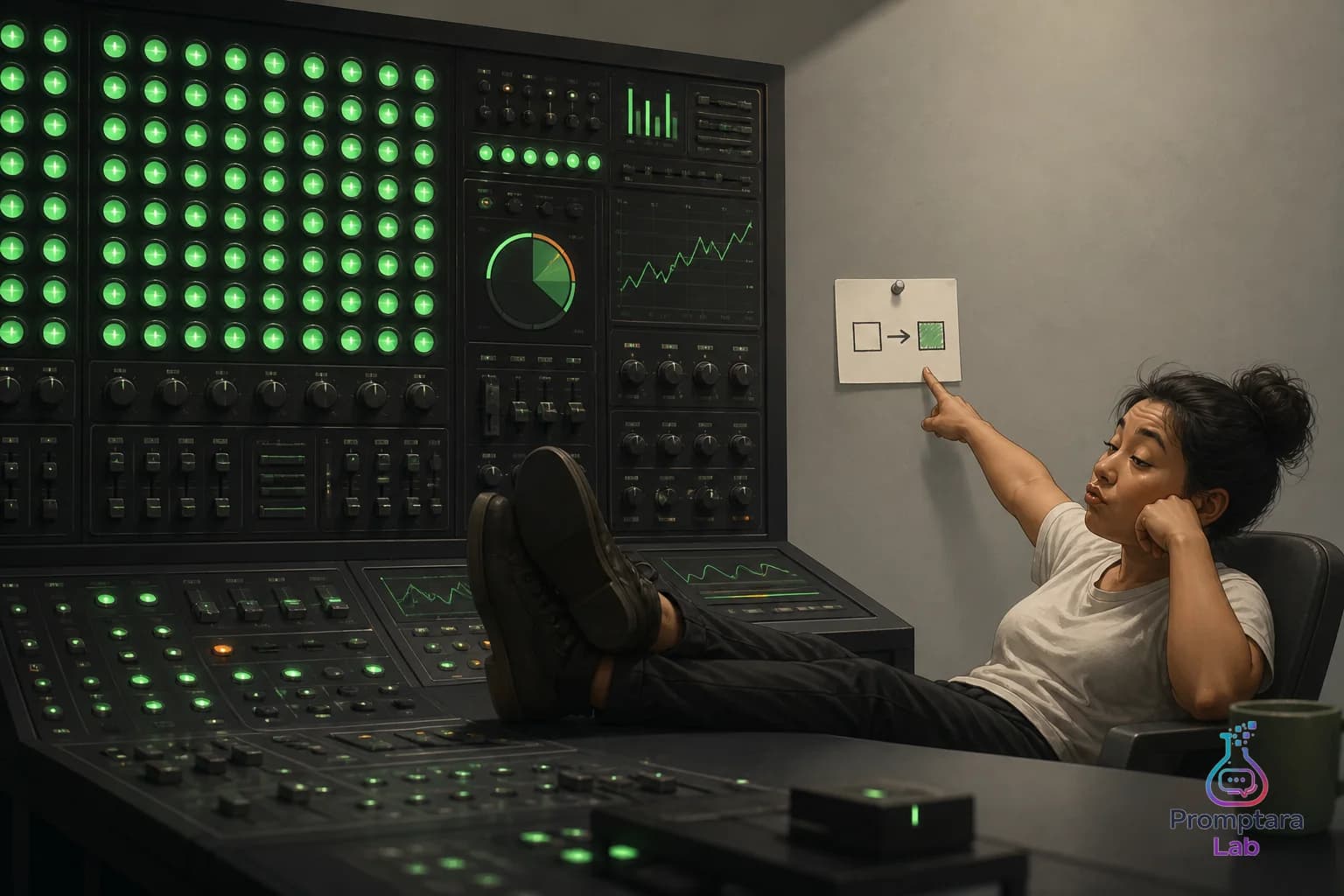
Traffic Without Appetite

A visit without an action looks tidy in a dashboard and annoying in a business.
That combination is dangerous. Tidy numbers invite tidy conclusions. Someone arrived, did not subscribe, did not submit, did not request access, did not ask for help, did not complete whatever tiny promise the page was hoping for. The cheap interpretation is that the page failed.
Maybe.
But small product systems do not get enough signal to spend it on theatrical certainty. Traffic without a tracked action is a branch in the diagnostic tree. It is not a verdict. Treating it as a verdict is how builders end up rewriting the offer, changing the CTA, adding popups, and generally turning a quiet page into a mall kiosk with abandonment issues.
At Promptara Lab, the more useful habit is slower and less satisfying: separate arrival from appetite.
The click is not the appetite
Traffic means someone reached a surface. That is all.
It does not prove they wanted the product. It does not prove they understood the offer. It does not prove the page was persuasive. It also does not prove the opposite.
A person looking for a recycling answer may want a disposal decision, not a relationship. A person reading about coffee gear may be trying to diagnose bitterness before buying anything. A person checking a grooming routine may want one practical adjustment and then leave, correctly. In those cases, no tracked action may mean the page did its job too quietly for the business model to notice.
That is the awkward part of utility content. Useful pages can satisfy demand without capturing it.
So the first question is not why did nobody convert. The first question is what kind of intent did this page invite.
Some pages are transactional. Some are educational. Some are trust building. Some are answer machines. If all of them are judged by the same action counter, the operating system starts punishing pages for having the wrong personality.
No action is still a branch
When traffic shows up with no same day action, there are at least four different readings.
One: the visitor had no appetite for the action. Fine. That is useful.
Two: the action was present but mismatched. A waitlist ask on a page solving a small immediate question can feel like asking someone to join a club because they borrowed a pen.
Three: the page answered the job completely. That sounds bad only if every page is expected to become a lead form. Many small products need trust, repetition, and memory before they earn a hand raise.
Four: the measurement is incomplete. This one is boring and brutal. If the system cannot see the relevant behavior, the absence of an action is not the same as zero interest. Promptara Lab has already written about this distinction in A Missing Measurement Is Not Zero, and it keeps paying rent.
The point is not to excuse weak pages. Plenty of pages are weak. The point is to avoid charging the wrong suspect.
A flat action counter can indicate a product problem, a page problem, a timing problem, an offer problem, an instrumentation problem, or no problem at all. The builder job is to narrow the branch before reaching for the chainsaw.
The small portfolio trap
A portfolio makes this harder because the dashboard puts unrelated things next to each other and dares the operator to compare them.
That is how nonsense sneaks in. A health insurance explanation, a plant planning tool, a local park guide, a coffee article, and a security page are not competing in the same intent market. Their visitors arrive with different stakes, patience, and willingness to act.
The dashboard flattens those differences because dashboards are little bureaucrats. They like rows. They do not care that one row represents a person trying to understand a confusing bill and another represents someone figuring out what to do with old cables.
This is where domain judgment has to interrupt the spreadsheet.
A good product system should ask whether the tracked action matches the page job. If the action is too heavy, make it lighter. If it is too vague, make it more specific. If the page is purely informational, decide whether success should include an action at all or whether the next useful signal is return visits, related page depth, or a later direct action.
Do not ask every page to behave like a checkout screen. That is how helpful products become needy products.
Design for the next honest question
Traffic without actions should lead to better questions, not louder furniture.
Before changing the product, inspect the contract on the page:
- What was the visitor probably trying to finish?
- Was the action a natural next step or a business wish stapled to the bottom?
- Could a smaller action reveal intent without demanding commitment?
- Is the measurement capable of seeing the behavior that would prove usefulness?
- Are similar pages being compared, or is the portfolio mixing apples, cable drawers, scalp care, and compliance anxiety?
That last one is less elegant, but it is usually where the leak is.
For an AI assisted portfolio, the publication engine can keep creating surfaces and the agentic framework under the hood can keep collecting signals. The machine can do that part without making a face. The operator still has to decide which numbers deserve interpretation.
Sometimes the honest note is that there was traffic, no tracked action, and no strongest traffic to action signal available. That line feels unsatisfying because it refuses to become a story. Good. A product operating system should be allowed to say none without immediately being accused of lacking ambition.
The useful move is not panic. It is labeling.
Label the page job. Label the intended action. Label the measurement gap. Label the next question. Then change one thing small enough that the next read is cleaner than the last one.
Promptara Lab keeps building around that kind of restraint because small products do not need more confident dashboards. They need fewer fake verdicts. The public notes at Promptara Lab are partly a record of that bias: let the system run, but do not let it pretend every quiet number is a confession.