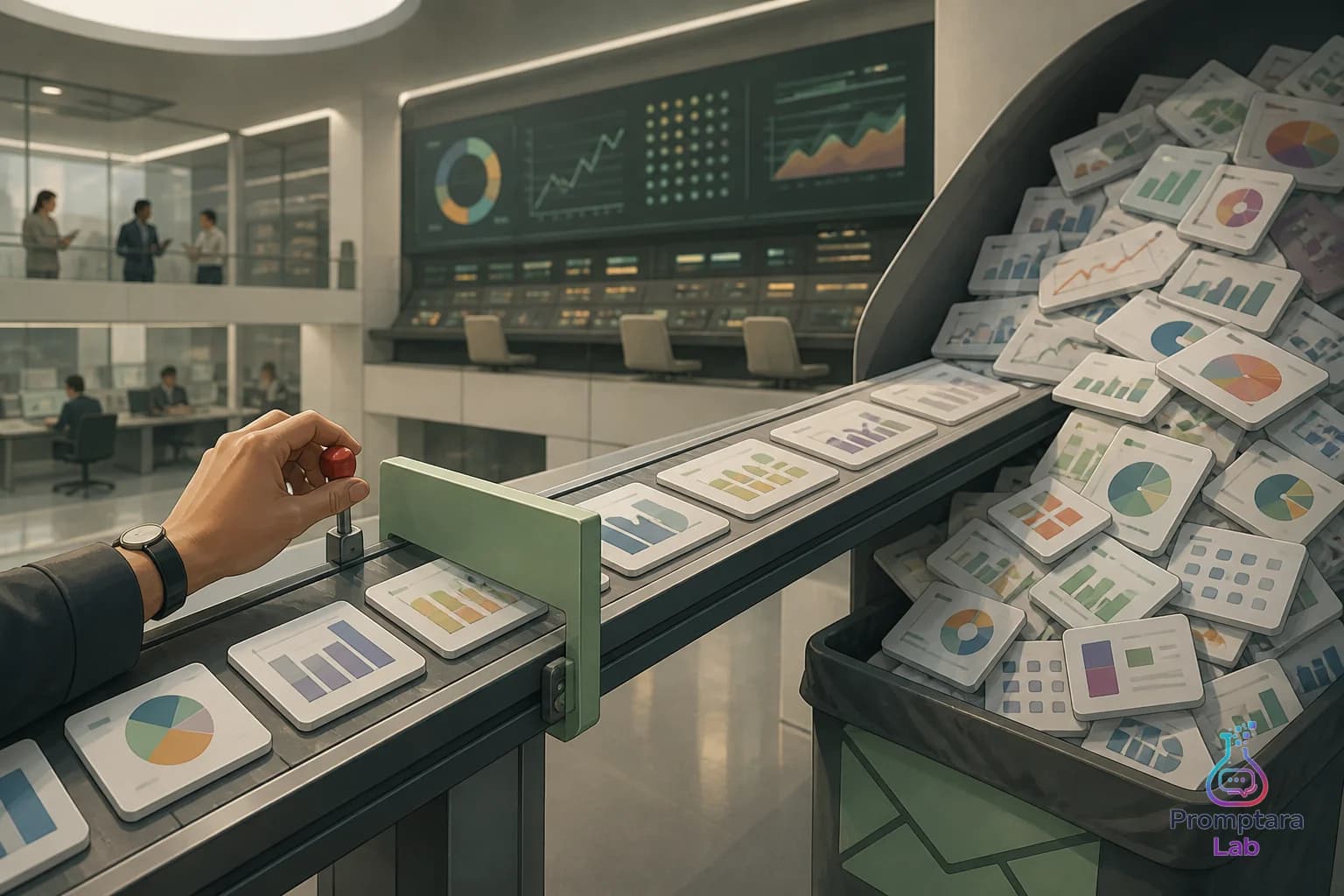
Put the Meter Next to the Machine

The dangerous version of cheap automation is not the expensive bill. It is the cheap bill that lets sloppy work pass as harmless.
A small AI assisted product system can now generate drafts, inspect signals, summarize usage, propose opportunities, and prepare publication material for less than the cost of lunch. That sounds lovely until the machine starts converting every faint twitch into another thing a human has to read, approve, route, archive, or ignore.
Cost telemetry belongs beside the machine, not in a separate accounting drawer. A daily usage line that says 35 requests, 94,495 input tokens, 75,737 output tokens, and $2.73 in spend is not a victory lap. It is a meter. The job of the meter is not to shame the builder. It is to keep the builder honest about what the system asked the model to do.
Promptara Lab keeps returning to this because an agentic framework under the hood can make the work feel weightless. It is not weightless. It just moved the weight into review, storage, decision making, and small recurring costs that are easy to ignore until they become the wallpaper.
Cheap runs still need taste
The lazy argument says that if an automated run is cheap, selectivity can wait. Let the system watch more sources. Let it create more observations. Let it draft more candidate ideas. Let tomorrow's human sort it out.
That is how a builder accidentally hires themselves as a landfill operator.
A signal pass that sees 100 items and inserts 6 is doing a different kind of work than one that sees 100 items and inserts 95. Neither is automatically better. The point is that the ratio asks a product question: was the machine filtering, or was it laundering noise into the database with better formatting?
The same goes for topic systems and publication systems. A low cost generation run can still create expensive clutter if it produces five plausible ideas that do not deserve action. Promptara Lab has already argued that output is inventory, not progress. Cost makes that inventory visible from another angle. Cheap inventory is still inventory. It takes up room. It asks for care. It creates false comfort.
The mistake is treating model spend as the only cost. The bigger cost is often decision fatigue wearing a little badge that says “draft created.”
Put spend beside selectivity
Cost telemetry gets more useful when it is read beside selectivity telemetry.
Not just: how much did the system spend?
Also: what did the system choose not to keep?
Also: how many candidates became useful records?
Also: how many generated things created a follow up obligation?
A cost line by itself can become a tiny vanity metric. Low spend feels responsible. High spend feels suspicious. Both reactions are too crude. A $2.73 day that produces a small set of useful decisions can be perfectly sensible. A $0.20 day that fills the queue with junk can still be bad product operation.
Spend is not a moral score. It is a constraint with a timestamp.
The better operating habit is to connect cost to the shape of the work. If a signal system observes a lot and inserts little, that may be healthy restraint. If it observes a lot, inserts a lot, and every inserted item needs human review, then the meter should make the builder ask whether the framework is helping or just wearing a very productive costume.
This is close to the discipline behind an opportunity is not a work order. A candidate can be useful without becoming a task. A run can be successful without producing a pile. A model call can be valid without deserving repetition.
Traffic can spend attention too
Usage cost is not only about model tokens. Product attention has its own meter.
When traffic appears without same day actions, the correct move is not panic. It is also not celebration. It is a diagnostic branch. People arrived, but the available evidence did not show contact submissions, follows, signups, searches, or other listed actions for the day.
That does not prove demand is absent. It does prove that the system should be careful before spending more generation effort on the same assumptions.
This is where cost telemetry and product telemetry should talk to each other. If a page gets visits but no action, an automated system can easily respond by making more posts, more variants, more intros, more explanations. Sometimes that is useful. Sometimes it is the machine trying to solve appetite with confetti.
A better response is narrower: what question should be answered before the next run spends attention? Is the call to action unclear? Is the audience wrong? Is the page promising the wrong thing? Is the measurement missing? If the answer is not available, say so. Do not let the model fill the silence with confidence.
The meter changes the conversation
Putting the meter next to the machine changes how a builder talks about automation.
Without the meter, the question is usually, “Did it run?”
With the meter, the questions get better:
Was the run small enough for the decision it supported?
Did it create review load in proportion to its value?
Did it preserve selectivity, or just convert observations into chores?
Did the cost line explain anything, or merely make the system look tidy?
Could the next run be narrower?
That last question is underrated. Automation culture loves expansion. More sources, more destinations, more formats, more retries, more channels. Narrowing feels less glamorous, which is probably why it works.
The point is not to starve the system. Promptara Lab exists to build a portfolio of AI powered micro businesses, not to cosplay as a spreadsheet monk. The point is to make sure the machine earns its repetition.
A public portfolio page like Promptara Lab can show the polished surface. The operating system underneath needs duller instruments: cost, selectivity, queue pressure, action signals, missing measurements, and refusal.
A meter will not tell a builder what to build. Good. It is not qualified.
It will tell the builder when the machine is quietly spending money, tokens, and attention to avoid making a sharper decision. That is already enough work for one little gauge.