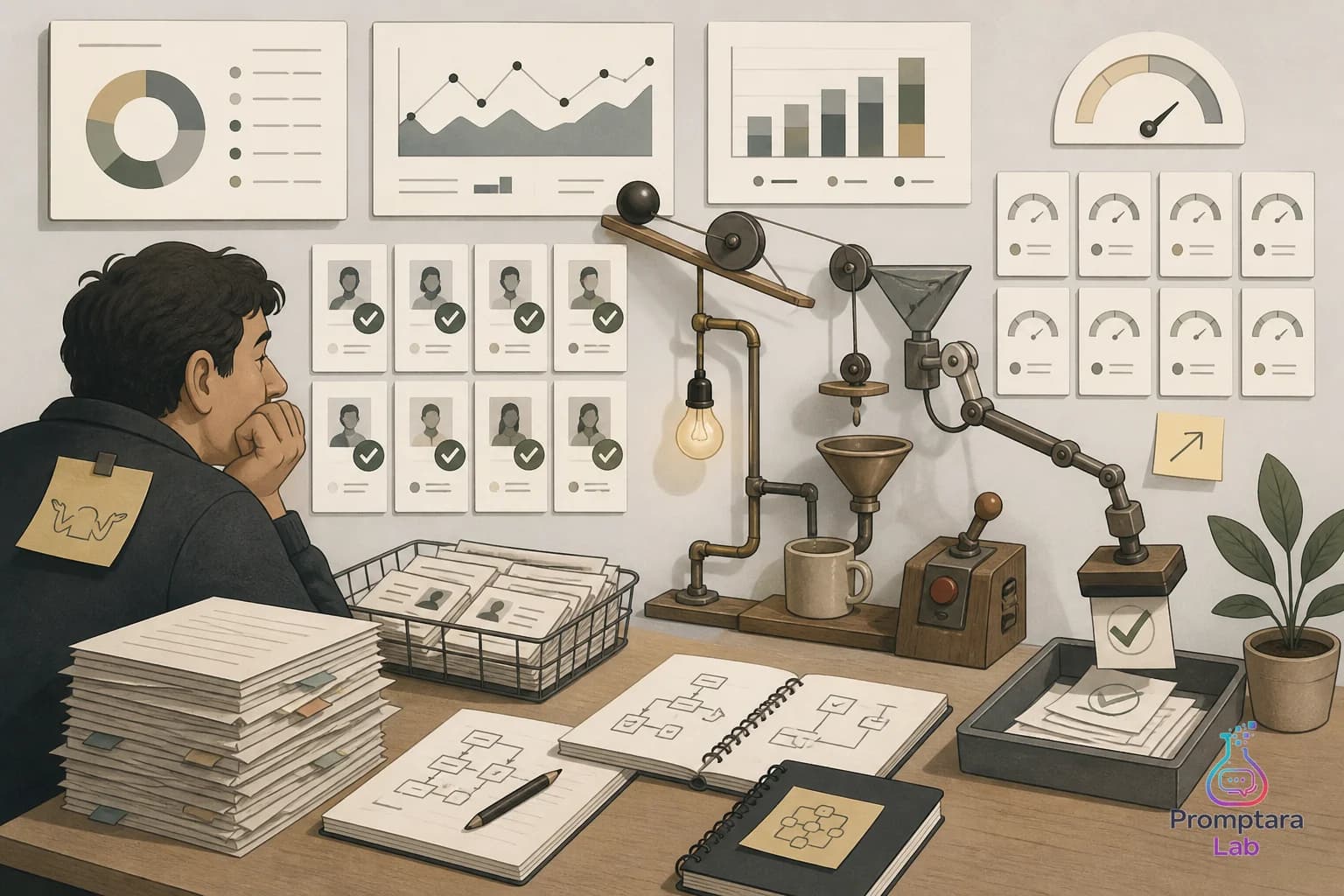
October Lab Notes: The Machine Can Wait

Introduction
The Lab Notes stay MDX first this month. That is not a formatting preference. Substack can be a channel later, but it is not the operating notebook. The portfolio needs the monthly notes to live beside the journal, the links, the metadata, and the rest of the product memory. Moving Lab Notes to MDX keeps the writeup closer to the evidence and farther from newsletter theater.
October opens with a familiar little trap: the automation stack did a lot of competent work, and most of it should not be mistaken for progress.
The backup completed. The health check reported healthy. The usage meter counted the prior day at $2.951035 across 36 requests, 116,009 input tokens, and 81,233 output tokens. The signal systems inspected the outside world across the portfolio. Draft packages moved through the publication engine for several assets. The intake router checked its queue more than once and found no new messages to take.
None of that is bad. It is the baseline. A small AI assisted portfolio should be able to wake up, check itself, count its cost, listen for signals, and avoid making a mess before coffee. The work this month is not to celebrate that the machine ran. The work is deciding what the machine is allowed to bother a person about.
Portfolio summary
Across the available signal runs, the agentic framework under the hood of Promptara Lab reported 1,145 observations, 101 inserted observations, and 386 opportunity candidates.
That is a useful pile. It is also a pile.
The asset level shape matters more than the total. BaldRoutine reported 111 observations, 16 inserted observations, and 61 opportunity candidates. One Perfect Park Day reported 94 observations, 35 inserted observations, and 14 opportunity candidates. BrewMatch reported 123 observations, 0 inserted observations, and 36 opportunity candidates. Mistoura Pastry reported 34 observations, 0 inserted observations, and 11 opportunity candidates.
Those are not interchangeable operating states. One asset found many fresh rows. Another saw plenty but inserted none. Another produced a large candidate set from a smaller fresh base. If those all collapse into one portfolio total, the operator loses the plot.
Promptara Lab's own signal run is a good example. It reported 95 observations, 15 inserted observations, and 39 opportunity candidates. The source mix was visible: 81 autocomplete observations and 14 forum observations. That split changes how the evidence should be read. Search suggestions and forum posts do not carry the same kind of intent, texture, or risk. We have covered this before in Source Mix Changes the Question, and the point keeps earning its rent.
The intake queue was also useful by not moving. Several checks reported 0 updates seen, 0 messages taken, and the same queue total before and after. That is not glamorous, but it is a state. An unchanged queue can mean stability, neglect, blocked intake, or simply no new material. The system should not get to pick the flattering interpretation by default. Unchanged Is Not Inspected is still the rule I want near this dashboard.
What shipped, and what did not
No recent git commits were available in the evidence for this run.
That sentence is not an apology. It is just a boundary. There is no basis here to claim a code shipment, a new product release, or a feature launch. A portfolio can change without a commit, but a build log should not launder operational activity into shipping language.
What did appear was publication inventory. BrewMatch had draft social packages around a coffee grinder presets article. BaldRoutine had draft social packages around dry scalp after head shaving. What Bin Is This had draft social packages around plastic takeout containers. The publication engine prepared channel specific drafts with uploaded media available to the system.
Drafts are not outcomes. They are review objects.
That distinction is boring until it saves the operator from a week of fake momentum. A draft can be well formed and still not deserve publication. A caption can be crisp and still be the wrong use of attention. A media object can be ready and still be attached to a topic that should wait. The draft queue is a product surface because it asks for judgment, not because it proves reach.
The traffic and action snapshot kept the same discipline. What Bin Is This had 7 visitors and 9 pageviews in the latest traffic intelligence. One Perfect Park Day had 4 visitors and 4 pageviews. Promptara Lab had 3 visitors and 3 pageviews. Oh My EOB had 3 visitors and 3 pageviews. Zero Drama Security had 1 visitor and 1 pageview. Orange Palm Gallery had 0 visitors and 0 pageviews in that snapshot.
The action side was thinner. BrewMatch had the strongest traffic to action signal in the snapshot: 1 action from 5 visitors. Its available monthly action total showed 10 match submissions. FSA Ready showed 10 claim checks and 1 waitlist signup in the available monthly action totals. Oh My EOB showed 2 contact messages in the available monthly total. BaldRoutine showed 1 lead capture in the available monthly total.
Revenue metrics were not available in the supplied evidence. Subscriber growth beyond the listed action counters was not available. So the honest read is narrow: there were small user actions, sparse across assets, with BrewMatch carrying the clearest same day signal in the snapshot.
In the lab
The useful internal work right now is not more output. It is better routing of attention.
The daily usage meter is part of that. The prior day cost was about three dollars. Cheap enough to ignore, which is exactly why it should not be ignored. Cheap runs still create review work. They create candidates, drafts, queue states, and little claims that want to sit in the operator's head.
The stack can now produce more evidence than one person should inspect at full depth. That means inspection depth has to be designed, not improvised. A health receipt does not need the same review as a candidate pool. A same day action does not need the same review as a quiet queue. A draft package does not need the same review as a backup receipt. Treating them all as equal is how a small portfolio turns into clerical fog. The related note, Inspection Depth Is a Design Choice, is basically the operating manual for this part.
This month, the better question is not whether the agents can see more. They can. The question is what gets promoted from seen to reviewable.
A few candidates earn that promotion:
- BrewMatch's small action signal, because a user did something rather than merely arrive.
- One Perfect Park Day's high insertion count relative to its opportunity count, because freshness and selectivity are doing something interesting there.
- BrewMatch's 0 inserted observations alongside 36 opportunity candidates, because that shape asks whether the candidate logic is drawing from older accepted material or whether freshness thresholds are too strict.
- The unchanged intake queue, because quiet systems still need a contract for what quiet means.
Everything else can wait.
That is not neglect. That is portfolio hygiene.
Experiments
The experiment for the next cycle is to keep slowing down the handoff between automation and attention.
The first rule is that a candidate is not a task. The portfolio produced 386 opportunity candidates across the available runs. If even a modest fraction of those became work orders, the system would be punishing the operator for installing good ears.
The second rule is that same day action gets priority over volume. BrewMatch's 1 action from 5 visitors is small. It is also more concrete than a large observation count with no user action attached. The number does not prove demand, but it earns a look.
The third rule is that zero has to keep its label. BrewMatch had 0 inserted observations in its signal run. Mistoura Pastry also had 0 inserted observations. Promptara Lab had 0 contact submissions and 0 follow subscribers in the action snapshot. Those are different zeros. Some belong to signal freshness. Some belong to user behavior. Some belong to distribution. Blending them into one sad bucket would be lazy.
The fourth rule is that no commit does not mean no operational change. It only means no recent code commit was available in the evidence. The system still ran, listened, drafted, counted, and checked itself. The build log should say that clearly without inflating it.
Lessons learned
The main lesson is that automation is getting better at producing plausible review inventory.
That sounds like praise. It is partly praise. But plausible inventory is dangerous because it asks to be trusted just enough to waste time.
The safer posture is slower and less flattering. A backup receipt is a receipt. A healthy status is a receipt. A usage meter is a receipt. A signal run is a receipt. A draft package is a receipt. An action counter is a receipt.
Only some receipts become decisions.
The operator's job is to preserve that gap. Machines love collapsing the gap because it makes the workflow feel tidy. Saw it, scored it, drafted it, routed it. Very satisfying. Also how a portfolio fills with work that nobody actually chose.
The wry version: the machine is allowed to bring snacks. It is not allowed to plan dinner.
Looking ahead
Next month, I want the Lab Notes to keep favoring selection over narration.
That means fewer grand conclusions from portfolio totals. More asset level reads. More attention to source mix. More explicit treatment of unchanged queues. More skepticism toward draft volume. More willingness to say a metric was not available.
The useful portfolio is not the one with the biggest pile of generated material. It is the one where a person can tell, quickly, which few things deserve judgment today.
For October, that means BrewMatch gets the first chair because it produced the clearest small action signal in the available snapshot. The high fresh insertion run for One Perfect Park Day gets a closer look, but not a victory lap. The unchanged intake queue gets inspected as a state, not ignored as background. Draft packages stay drafts until reviewed.
The machine can wait. That might be the most operator friendly feature in the whole system.