Founder Journal: The Small Action Gets the Chair
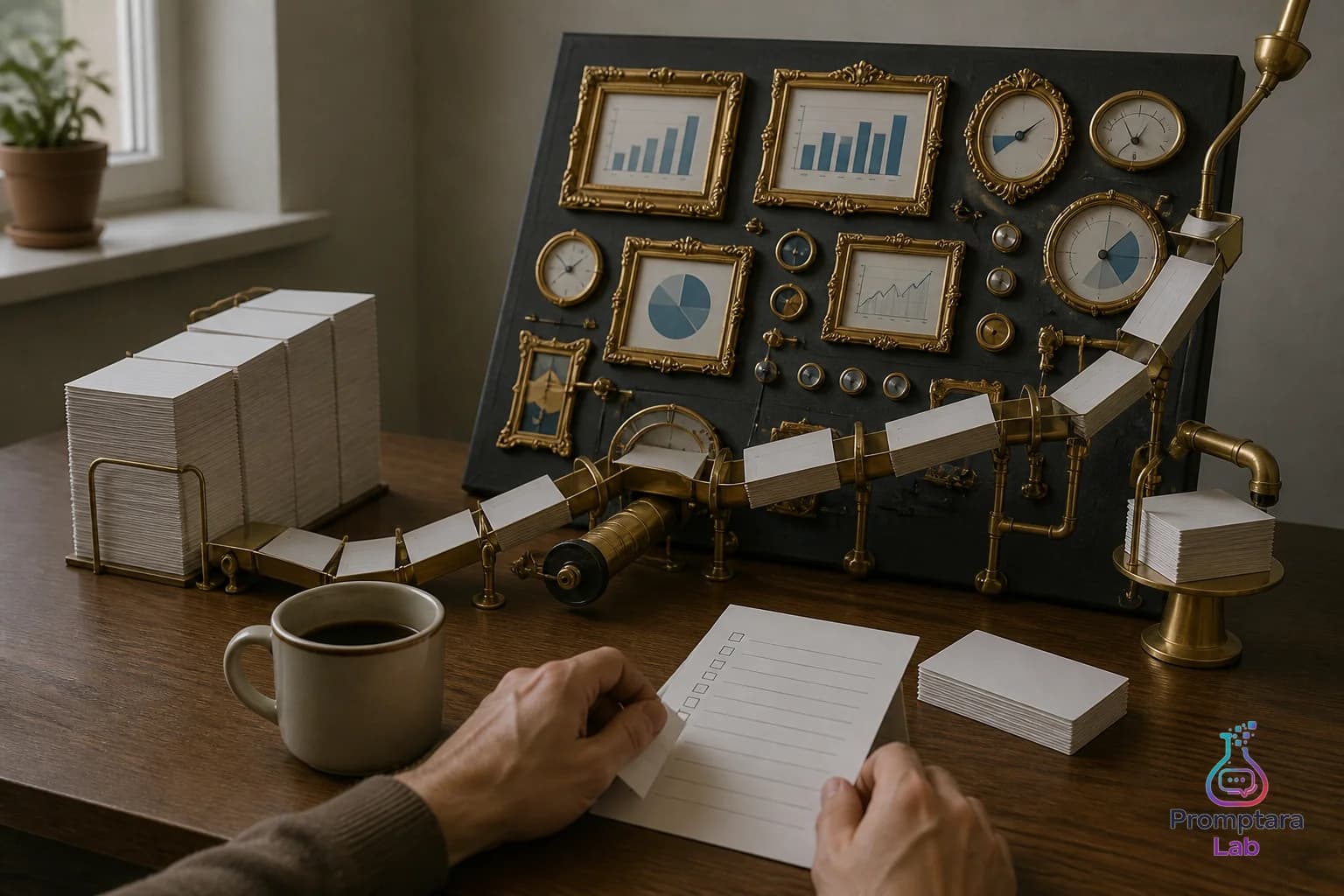
The portfolio made the usual mistake available this week: it offered me a big number and a small decision at the same time.
Across the available signal runs, the agentic framework under the hood of Promptara Lab reported 1,150 observations, 104 inserted observations, and 384 opportunity candidates. That is a respectable pile. Not a magical pile. Not a strategy. A pile.
Then FSA Ready put a much smaller object on the table: 1 claim check and 1 waitlist signup, with the traffic snapshot marking it as the strongest traffic to action signal at 2 actions from 6 visitors. The signup source was reported as hero.
That is not enough data to throw a parade. It is enough to move the chair.
The small action changed the reading order
The temptation in a portfolio review is to start where the machines were busiest. That feels responsible because the numbers are larger. More observations. More candidates. More inserted rows. More records to inspect. Bigger columns look like they deserve the first word.
They often do not.
This week, the first review slot belongs to the small action, not the tall signal stack. FSA Ready did not have the biggest signal run. Its available signal pass reported 91 observations, 1 inserted observation, and 12 opportunity candidates. Perfectly modest. Meanwhile, other assets produced more candidates, more insertions, or more visible search material.
But FSA Ready had the thing most portfolio telemetry is trying to approach without faking it: someone did something. One claim check. One waitlist signup. The signup source being hero is useful because it points to a specific surface, not a vague aura of interest.
The operator move is not to declare product market fit from two actions. That would be arithmetic cosplay. The move is to ask what the hero promised, what the visitor likely understood, and whether that promise deserves more careful inspection than another batch of candidate topics.
I keep returning to the idea that ratios are questions, not grades. Two actions from six visitors looks tidy, but the ratio is not a trophy. It is a question with a very small denominator and a useful scent.
Volume still earned a seat, just not the head of the table
The signal system was not useless this week. It did what it is supposed to do: look around, preserve candidates, and make the review surface less dependent on my memory.
The spread mattered. One Perfect Park Day reported 92 observations, 40 inserted observations, and 15 opportunity candidates. Piko Thread Editions reported 95 observations, 18 inserted observations, and 46 candidates. Promptara Lab itself reported 98 observations, 17 inserted observations, and 42 candidates. What Bin Is This reported 123 observations and 45 candidates, but 0 inserted observations.
Those are different shapes. A system that flattens them into one total is asking to be misunderstood.
A run with many observations and no new insertions is not a failure by default. It may mean the system saw familiar material. A run with many insertions is not automatically a mandate to publish. It may mean the outside world was noisy in a fresh way. A run with fewer candidates may still matter more if it sits near a product surface that got an actual action.
This is where the portfolio starts to feel less like a content machine and more like inventory control. The inventory is not just drafts or topics. It is attention. Every candidate accepted into review is a tiny claim on future judgment. Some claims are worth it. Some are just wearing a fresh timestamp.
That is why I try to read signal volume beside action evidence, not before it. Seeing more is useful. Selecting better is the job.
Quiet assets need labels, not shame
Several assets had traffic without actions in the snapshot, including Promptara Lab, BrewMatch, BaldRoutine, Oh My EOB, My Plant Planner, One Perfect Park Day, Mistoura Pastry, Fred Descloux, and Zero Drama Security. That list is too varied to treat as one diagnosis.
Promptara Lab had 2 visitors and 4 pageviews, with 0 contact submissions and 0 follow subscribers. Zero Drama Security had 5 visitors and 6 pageviews, with 0 contact submissions and 0 email followers. One Perfect Park Day had 4 visitors and 10 pageviews, with 0 email followers. Oh My EOB had 2 visitors and 5 pageviews, with 0 same day contact messages in the snapshot, though the week total showed 1 contact message.
Those are not the same product situation. They only look the same if the dashboard stops at zero actions.
The useful reading is narrower. Some pages may have weak calls to action. Some may attract informational visits that were never close to acting. Some may be early enough that the action mechanism is not yet earning trust. Some may simply have too little traffic to deserve drama.
I do not want the system to punish every quiet asset. I want it to label the quiet correctly. There is a difference between no appetite, no measurement, no clear next step, and no meaningful sample. Treating all four as the same zero is how a small portfolio starts making confident dumb decisions.
The same day window is especially easy to overread, which is why the earlier note on same day attribution being a very small window still applies. Same day action is useful when it appears. Its absence is not a clean verdict.
Cheap runs still spend attention
The prior day’s AI usage meter reported $2.551533 across 30 requests, with 131,618 input tokens and 69,835 output tokens. That is not financially scary. It is also not free in the only way that matters to this operating model.
The money meter is the easy one. The review meter is harder.
A cheap run that creates a lot of candidates still creates review pressure. A cheap run that drafts channel copy still creates QA pressure. A cheap run that reports healthy status still requires the operator to know what healthy does and does not mean. The cost line says the machine did not spend much cash. It does not say the output deserves a human minute.
This is the part people get wrong with small AI assisted systems. They compare automation cost to a contractor invoice and feel clever. Fine. But the actual constraint in a portfolio like this is not only cash. It is whether the operator can keep making clean decisions without turning every generated object into homework.
That is why attention is the scarce system resource remains one of the less glamorous rules here. The point of the framework is not to produce more things for me to admire. It is to make the next decision sharper.
The build note for next week
No recent git commits were found in the available evidence. That does not make the week empty. It makes it an operating week rather than a shipped code week.
The boring layer held: health reporting completed successfully, backup completed successfully, intake checks saw no new messages taken, and the publication side produced draft records where it was asked to. Useful. Not headline material.
The founder note is narrower: when a small verified action appears, it gets reviewed before the prettier pile.
Next week, FSA Ready’s hero deserves inspection before I go spelunking through every fresh candidate list. Not because two actions prove the asset is working. Because two actions are enough to ask a better question than the signal pile can answer by itself.
The portfolio does not need more reverence for big numbers. It needs better manners around small evidence.