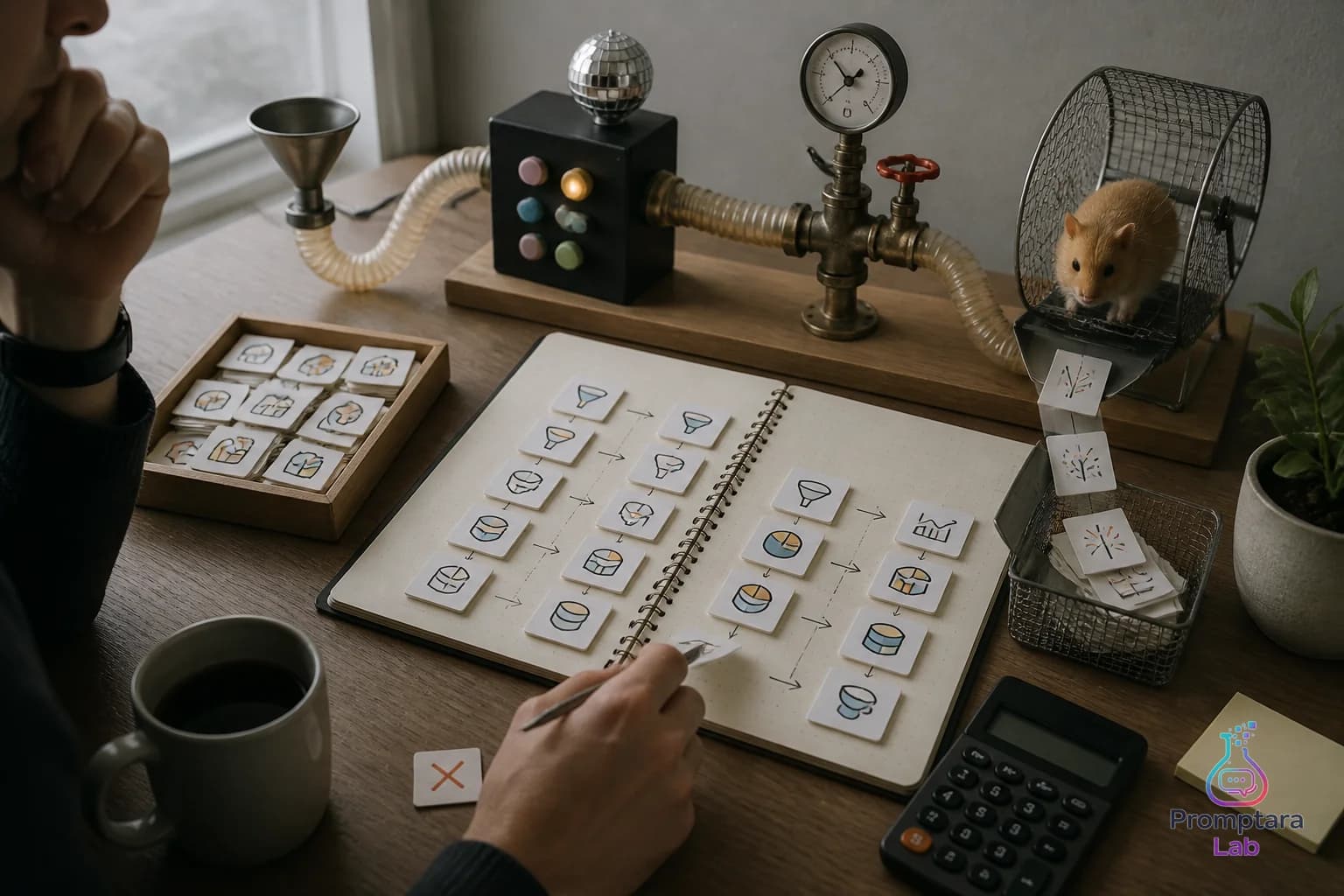
August Lab Notes: The Portfolio Got More Inspectable

Introduction
This edition moves Promptara Lab Notes to MDX first.
Not because MDX is magic. It is not. It is just a better fit for a portfolio where the journal, the product surfaces, and the operating notes should live in the same basic publishing shape. Substack is good at being Substack. The lab notes need to behave more like part of the system, not a postcard sent from outside it.
That is the tone of the month, really. Less romance about output. More attention to whether the portfolio can be inspected without turning every morning into archaeology.
The agentic framework under the hood of Promptara Lab had a busy month in the unglamorous places: telemetry, signal intake, content and backlink intelligence, SEO scouting, relationship intelligence, weekly microasset newsletter work, and operational wiring. The commits do not read like a launch parade. Good. A launch parade is usually where boring systems go to hide.
The useful question for this month was narrower: can the portfolio tell the operator what happened, what changed, what cost money, and what still needs judgment?
Portfolio Summary
The clearest operating evidence from the latest internal telemetry was not a growth chart. It was a set of receipts.
On the latest daily usage report available, API activity for July 31st recorded 34 requests, 115,547 input tokens, 64,130 output tokens, and $2.34 in cost. That is not a monthly spend number. It is one daily meter. Still useful. A machine that can produce drafts, signals, and summaries cheaply can also produce a lot of junk cheaply. The price tag is low enough to tempt sloppy thinking.
That is why the meter belongs close to the work. I wrote about this separately in Put the Meter Next to the Machine, and the point keeps getting less theoretical. Usage data by itself does not say whether the work was good. It does say whether the system is becoming expensive, noisy, or oddly quiet.
The routine operations also looked clean in the sampled telemetry: database backups completed, a larger backup job completed, and a health check reported healthy. Notifications were sent for the jobs that needed operator confirmation. That is boring in the correct way.
There were also no new intake messages taken during several sampled intake passes. The queue did not move. That is not failure. It is an empty row, and empty rows earn their place when they prevent the operator from inventing motion. The portfolio has had enough of that particular nonsense. See also The Empty Rows Earned Their Keep.
Revenue metrics were not available in the supplied evidence, so this note does not pretend to have them.
Assets shipped, with receipts not victory laps
Shipped is doing some work in this heading, so let’s make it behave.
The internal content metrics show draft social packages created for three assets on July 31st:
- BrewMatch prepared a content package around coffee that tastes bitter but weak.
- BaldRoutine prepared a content package around moisturizing a bald head daily without feeling greasy.
- What Bin Is This prepared a content package around whether empty propane tanks can go in the trash.
The publication engine created draft posts for multiple channels, and media upload status was recorded as successful for those packages. The evidence does not prove final publication, audience response, or business outcome. It proves preparation and handoff into the review and publishing surface.
That distinction matters. Output is not progress just because it exists. Output becomes progress only after it clears the next decision: publish, edit, reject, fold into another asset, or park it because the queue is already full.
The portfolio now has enough moving pieces that draft inventory is a real product surface. A draft queue can rot. It can also teach. The difference is whether the system preserves the reason each item exists and whether a human can decide quickly without rereading the entire internet.
The content topics themselves were nicely grounded in domain nouns: bitter coffee, scalp moisturizer, propane tanks. That is not a small thing. Generic AI content often floats above the problem like it is afraid to touch the counter. The asset-specific nouns keep the work closer to the user’s actual errand.
In the Lab
The July commit history points toward a portfolio that is being made more observable, not merely more prolific.
Recent work landed around telemetry, signal intelligence, content and backlink intelligence, SEO scouting, relationship intelligence, weekly microasset newsletters, and operational wiring. None of those phrases should be mistaken for outcomes. They are capabilities and surfaces. Their job is to reduce operator fog.
The latest signal intelligence runs are a good example. Across the listed assets, internal telemetry recorded 1,038 observations, 68 inserted observations, and 334 opportunity candidates. That covered assets including Orange Palm Gallery, BaldRoutine, Promptara Lab, What Bin Is This, Zero Drama Security, BrewMatch, Oh My EOB, FSA Ready, My Plant Planner, One Perfect Park Day, and Mistoura Pastry.
Those are not 334 tasks. Treating them that way would be a fine way to build a beautifully automated swamp.
An opportunity candidate is a question with a receipt attached. Maybe it becomes a post. Maybe it becomes product copy. Maybe it becomes a new landing page. Maybe it becomes nothing because it is too thin, too repetitive, or too far from the asset’s actual promise. I keep returning to this because the machine is now good enough at finding possible work that the scarce thing is not ideas. The scarce thing is refusal. More on that in An Opportunity Is Not a Work Order.
A few asset-level details stood out in the latest signal pass. One Perfect Park Day had 26 inserted observations from 87 observations, while FSA Ready and Mistoura Pastry had zero inserted observations in their runs. That does not automatically make one asset healthier than another. It says the filter behaved differently across domains on this pass. That is the kind of thing worth watching over time before drawing grand conclusions.
Experiments
The biggest experiment this month is not a new public feature. It is the shift toward MDX-first operating notes.
The old shape encouraged a journal as distribution artifact. The new shape treats the journal as a portfolio object. That means internal links can point to prior operating decisions. The table of contents can be useful. The note can sit alongside other product content without needing a separate editorial habitat. Small thing, large maintenance benefit.
Another experiment is the continued tightening of meters around automation. The usage report is small, but it gives the operator a number to place beside the day’s outputs. If a day produces a mountain of drafts for a couple of dollars, the cheapness is not the victory. The review load is the bill arriving in a different envelope.
Traffic and action data gave a similar reminder. The latest traffic snapshot showed Oh My EOB with 1 action from 2 visitors. It also listed 11 assets with traffic but no same-day actions, and no actions without same-day traffic. That is not enough to crown a winner or bury anything. It is enough to keep the question honest: which visits carried appetite, and which visits merely proved that a page could be reached?
The portfolio is still too small for dramatic claims. That is fine. Dramatic claims are usually what people reach for when the evidence is thin.
Lessons Learned
The first lesson: green checks are receipts, not verdicts.
A backup completing, a health check passing, a signal run finishing, or a draft being created tells us the machine executed. It does not tell us the business improved. That gap is where a lot of AI assisted portfolios will fool themselves. The system can be operationally healthy while commercially unproven.
The second lesson: zero and missing are different animals.
Some actions were recorded as zero. Revenue metrics were not available in the supplied evidence. Those should not be collapsed into the same mental bucket. Zero says something was measured and did not occur. Missing says the note does not have evidence. Confusing those two is how dashboards become fiction with nicer spacing.
The third lesson: selectivity is a feature.
The signal system observed far more than it inserted. Good. If every observation becomes durable inventory, the database becomes a junk drawer with timestamps. The inserted observation count is one way to see that filtering is happening. It is not proof that the filter is right, but it is proof that the system is not accepting everything with a pulse.
The fourth lesson: the queue is part of the product.
Drafts, opportunities, notifications, and intake items are not backstage clutter. They are the operator interface. If they are noisy, vague, or overconfident, the portfolio gets harder to run even while the automation looks more capable.
Looking Ahead
The next month should not be about making the machine louder.
The better work is narrower:
- Keep usage meters close to generated work.
- Keep opportunity candidates separate from approved work.
- Keep empty runs visible when they prevent false motion.
- Keep MDX notes connected to prior operating decisions.
- Keep traffic and action data modest, literal, and free of wishful math.
There is also a plain review burden to manage. The portfolio can now create enough drafts and candidates that the bottleneck shifts toward judgment. That is not a failure of automation. That is automation reaching the point where taste, relevance, and restraint matter more.
The temptation will be to add more lanes, more feeds, more prompts, more surfaces. Some of that may happen. But the useful constraint is to add only what can be inspected without creating a second job called inspecting the inspector.
Closing Thoughts
This month’s progress looks like a system becoming easier to question.
That is less exciting than saying the portfolio exploded, scaled, unlocked, or whatever other verb gets thrown at small machines trying to earn their keep. But it is more useful.
Promptara Lab is still a portfolio of small AI powered assets under construction. The evidence available this month shows operating receipts, draft preparation, signal flow, modest traffic, sparse actions, and better instrumentation. It does not show revenue, audience scale, or clean proof of product demand.
Good. The notes should not pretend otherwise.
The work now is to keep the system legible as it gets more capable. More output is easy. More inspectable output is the part worth building.