
Source Mix Changes the Question
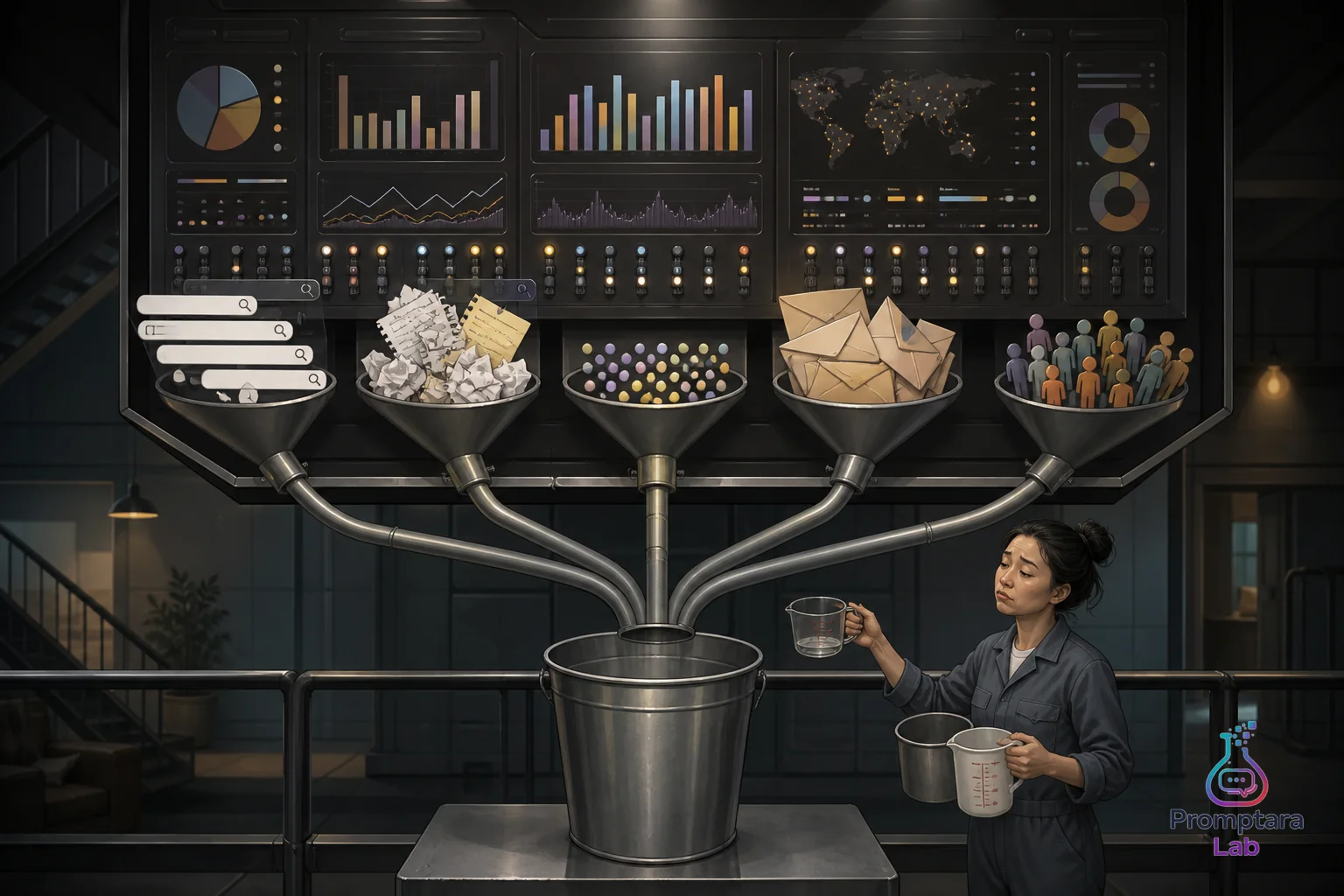
A signal system gets sloppy the moment it pretends all inputs speak the same language.
Search suggestions are not forum posts. A pageview is not a contact message. A queue that stayed the same is not the same kind of evidence as a newly inserted observation. These things can sit in one database, one report, or one tidy morning notification, but they did not come from the same kind of human behavior.
That distinction is easy to lose once automation starts doing the gathering. The machine sees items, normalizes them, counts them, filters them, and turns some of them into candidates. The result looks cleaner than the world it came from. That is useful for review. It is also where interpretation can quietly go soft.
In one recent Promptara Lab signal pass, the system reported 99 observations, 18 inserted observations, and 34 opportunity candidates. The source mix behind those observations was uneven: 81 came from search autocomplete style inputs and 18 came from forum style inputs. That is not a bad mix. It is not a good mix either. It is a clue about the kind of question the system was mostly asking.
Volume does not wash out source bias
A larger pool can still be lopsided.
Search autocomplete tends to compress behavior into short phrases. It is good at showing how people frame a query when they are trying to find something. It often rewards nouns, modifiers, and familiar wording. It can make a topic look crisp because the language has already been flattened by the search box.
Forum material is messier. People complain, ramble, answer each other badly, tell stories, skip context, overexplain context, and use words no keyword tool would politely choose. That mess is not a defect. It is often where product friction shows up before it becomes a clean query.
If most observations come from search style sources, the resulting opportunity pool may lean toward explainers, comparison pages, definitions, and content surfaces. If more observations come from forum style sources, the pool may lean toward objections, workflow gaps, support language, and product questions. Neither source is morally superior. They are just different witnesses.
The mistake is treating a blended total as if it has become neutral. It has not. A smoothie still has ingredients, even if the dashboard serves it in a nice glass.
Acceptance does not erase ancestry
Filtering a signal does not remove where it came from.
A system can observe 99 items, insert 18 new observations, and propose 34 candidates. Each step adds judgment. That judgment matters. But the accepted items still inherit the shape of the source pool. If the system mostly observed search phrases, then the accepted material may still be pulled toward search shaped language. If the system mostly observed forum complaints, then the accepted material may still overrepresent people with enough irritation to post publicly.
This is where small product systems can accidentally overtrust their own neatness. The review screen shows opportunity candidates. The candidates have labels. The labels look comparable. Now a builder is tempted to rank them as if each row is the same unit.
It is not.
One candidate may be backed by repeated query phrasing. Another may be backed by a single vivid complaint. Another may exist because the system inferred a gap between what people ask and what the product currently explains. Those are different reasons to care. They call for different next moves.
Promptara Lab keeps source provenance visible for exactly this reason. A source label is not administrative decoration. It is part of the evidence. The older note on source provenance as product context makes the same argument from a slightly different angle: a signal without its source attached is context with the label scraped off.
Mixed sources need mixed review questions
A source aware review does not need to be elaborate. It needs better questions.
Start with dominance. Which source shaped most of the pool? If search supplied the bulk of the observations, then the review should ask whether the candidates are mostly content phrasing problems. If forums supplied the bulk, the review should ask whether the candidates contain unresolved product language, objections, or workflows that deserve closer inspection.
Then ask what is absent. A pool with many observations and no same day actions tells a different story than a pool paired with contact messages or signups. In the available traffic intelligence, several assets had traffic without same day actions, and the strongest traffic to action signal was not available. That does not prove the signal sources were wrong. It does mean the system should resist pretending that visibility and appetite are the same thing.
Also check stillness. An intake queue that sees 0 updates, takes 0 messages, and stays at the same total is not empty evidence. It says the watched surface did not move during that pass. That kind of source has a different job than a discovery source. It is closer to a guardrail than a generator.
The review should match the witness.
Search asks: what are people trying to name?
Forums ask: what are people struggling to explain?
Traffic asks: did anyone show up?
Actions ask: did anyone cross a threshold?
Queues ask: did anything require handling?
Throw those into one undifferentiated opportunity list and the system becomes more confident while the operator becomes less informed. Very efficient. Slightly cursed.
Keep the seams visible
The goal is not to keep every source in its own museum case. Blending sources is useful. A good opportunity candidate often needs more than one kind of evidence around it. Search language can show discoverability. Forum language can show pain. Traffic can show surface contact. Actions can show willingness to do something.
But the seams should remain visible during review. A builder should be able to tell whether a recommendation is mostly a search artifact, mostly a complaint artifact, mostly a traffic artifact, or a genuine overlap.
That is the operating principle: source mix is not an implementation detail. It is the shape of the question the system asked before it handed you an answer.
For Promptara Lab, the useful version of automation is not the one that makes evidence look frictionless. It is the one that keeps just enough friction in the record for a human to notice what kind of evidence they are holding.
Clean tables are nice. Honest tables are better.